Walkers Rewrites Its Brand Code
Why Britain’s biggest crisp brand isn’t just changing its logo — it’s redefining what heritage means in modern branding
When Walkers unveiled its new logo this week, the immediate reaction across mainstream media was predictable. Headlines focused on whether the design hid a “secret meaning,” whether it felt too modern, or whether a national icon should ever be touched at all. But those questions miss the real story.
This is not a cosmetic refresh. Nor is it a late attempt to look contemporary. Walkers’ new identity represents something far more consequential: a recalibration of how a mass-market heritage brand survives in an era defined by regulation, private-label pressure, cultural fragmentation and declining trust in advertising itself.
For branding professionals, this moment deserves careful attention. Because beneath the sunburst motif and refreshed packaging lies a sophisticated strategic move — one that signals how category leaders are quietly adapting to a world where familiarity alone is no longer enough.
A brand too big to hide
Walkers occupies a rare position in British culture. It is not just a brand people buy; it is one people recognise instinctively. The red and yellow palette, the typography, the pack shapes — these elements have become visual shorthand for crisps themselves. That level of recognition is both an asset and a constraint.
For decades, Walkers’ dominance allowed it to remain visually stable while the market shifted around it. But that stability has increasingly become a liability. Supermarket own-labels have improved in quality and confidence. Premium challengers have reframed snacks as artisanal, global or health-conscious. Younger consumers have shown less brand loyalty and more appetite for novelty.
In that context, not changing would have been the riskier decision.
Why now matters more than what
Timing is everything in branding. Walkers’ decision to introduce its largest visual overhaul in nearly eighty years is not arbitrary.
The snacks category is under pressure from multiple directions at once. Regulatory scrutiny around food marketing is intensifying. Price sensitivity is rising. Shelf space is more competitive. And attention — the most valuable currency in branding — is increasingly scarce.
This refresh arrives at a moment when Walkers needs to do three things simultaneously:
Defend its leadership position against own-label erosion
Reassert cultural relevance beyond habit and nostalgia
Create headroom for future growth without alienating its core audience
The new identity is designed to do all three.
From product symbol to brand symbol
The most significant change in the new logo is not aesthetic; it is semiotic.
Historically, Walkers’ visual identity leaned heavily on literal product cues. The crisp itself — or references to it — anchored the brand firmly within its category. That approach works when a market is stable and dominance is unquestioned.
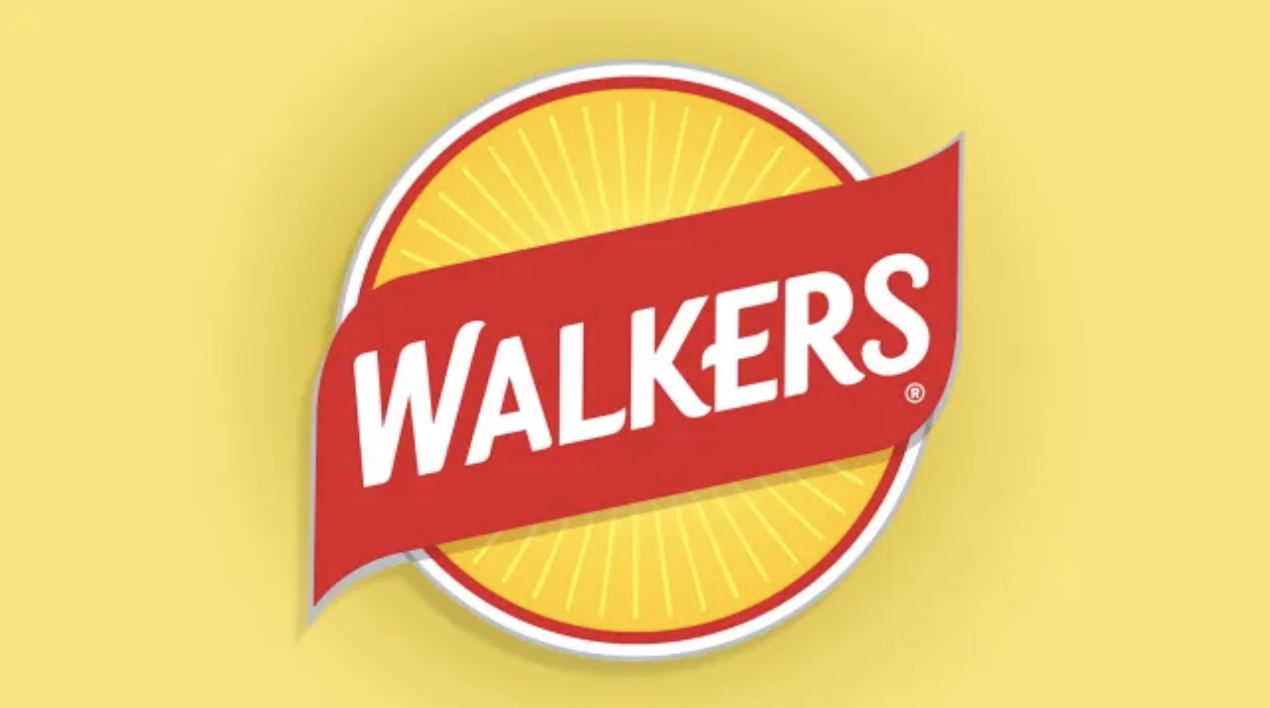
The new sunburst motif marks a deliberate departure from that logic. Instead of representing a product, it represents a feeling. Warmth. Energy. Optimism. Familiarity without specificity.
This shift matters because it subtly repositions Walkers from being about crisps to being about everyday enjoyment. That distinction creates strategic flexibility. It allows the brand to evolve, innovate and potentially expand without being visually trapped by its past.
For a brand of this scale, that is a carefully calculated move.
Heritage, carefully handled
One of the most telling details of the rebrand is not what changed, but what stayed.
Walkers has retained core colour equity, recognisable typography cues and clear continuity across its range. The founder’s signature has been reintroduced on packaging — a quiet but powerful signal of authenticity and provenance.
This is heritage treated as structure, not sentiment.
Rather than leaning into nostalgia, Walkers uses its history as a stabilising force. The message is not “remember when,” but “we’ve been here all along.” That distinction is crucial. Nostalgia looks backwards. Continuity reassures in the present.
Design as commercial architecture
For a mass-market brand, design is never just about taste. It is about behaviour.
Walkers’ new packaging system has been engineered to perform in the most unforgiving environment possible: the supermarket aisle. The refreshed visual hierarchy improves clarity at distance. The simplified central mark increases recognition across formats. The overall system creates consistency without uniformity.
This is design doing what it should do at scale — removing friction, accelerating choice, reinforcing memory.
Crucially, it also provides a strong foundation for promotional mechanics. The launch has been paired with a major on-pack activation, ensuring that the new identity is not passively noticed but actively engaged with.
Brand change without behavioural reinforcement rarely sticks. Walkers understands this.
Flavour innovation as signal, not gimmick
Alongside the new identity, Walkers has introduced a headline flavour designed to signal relevance rather than experimentation for its own sake.
The choice is telling. It taps into broader cultural taste trends without abandoning mass appeal. It communicates curiosity, not chaos. It positions Walkers as attentive to contemporary preferences while remaining accessible.
Importantly, the flavour launch is framed within the broader brand narrative rather than standing apart from it. Innovation here supports repositioning, rather than distracting from it.
A response to private-label pressure
One of the least discussed but most important drivers behind this rebrand is the rise of own-label snacks.
Supermarket brands have become more confident, more design-led and more competitive on quality. They are no longer trying to look cheap; they are trying to look smart.
In that environment, legacy brands cannot rely on familiarity alone. They must justify their presence — visually, emotionally and culturally.
Walkers’ refreshed identity reinforces its authority. It reminds consumers why this brand leads the category. Not through shouting, but through clarity and confidence.
What this tells us about modern branding
There are several deeper lessons here for brand leaders.
First, scale does not exempt a brand from evolution. It demands it.
Second, heritage is most powerful when it is structural, not sentimental.
Third, visual identity must articulate future intent, not just present recognition.
And finally, brand refreshes only work when they are integrated — when design, product, promotion and narrative move together.
Walkers’ rebrand is not flashy. It is not designed to provoke outrage or applause. It is designed to endure.
A mature move in a noisy landscape
In an era where rebrands often feel performative or superficial, Walkers has taken a different approach. This is branding as long-term infrastructure rather than short-term spectacle.
The brand is not trying to become something else. It is trying to remain itself — but in a way that makes sense for the next decade, not the last.
That restraint is precisely what makes the move significant.
Conclusion
Walkers’ new logo is not the story. The story is what the logo represents.
A recognition that even the most familiar brands must evolve to remain relevant. A willingness to reinterpret heritage without exploiting it. And an understanding that modern branding is less about shouting louder and more about standing for something clear, confident and adaptable.
For serious brand strategists, this is not a curiosity piece. It is a case study.
Frequently Asked Questions
Is Walkers changing its core product offering?
No. The core range remains intact, with innovation layered on top rather than replacing existing favourites.
Why move away from literal crisp imagery?
To create broader emotional meaning and future flexibility beyond narrow category cues.
Does this risk alienating loyal customers?
The redesign preserves key visual equities to maintain familiarity while modernising execution.
Is this primarily a design-led decision?
No. It is a strategic repositioning supported by design, product and promotion working together.
How does this affect Walkers’ competitive position?
It strengthens brand authority and differentiation in a crowded, price-sensitive category.
What can other heritage brands learn from this?
That evolution works best when it is deliberate, integrated and grounded in long-term intent.
Is this a response to private-label growth?
Yes, in part. The refresh reinforces value beyond price.
Will the identity continue to evolve?
The system has been designed to allow future adaptation without repeated reinvention.
Is nostalgia still important in branding?
Yes, but as structure rather than spectacle.
Why is this rebrand significant now?
Because it reflects how legacy brands must adapt in a regulated, fragmented and trust-conscious market.